Sep 08 2010

The Place of Discovery

Filed under: Coastal Journal

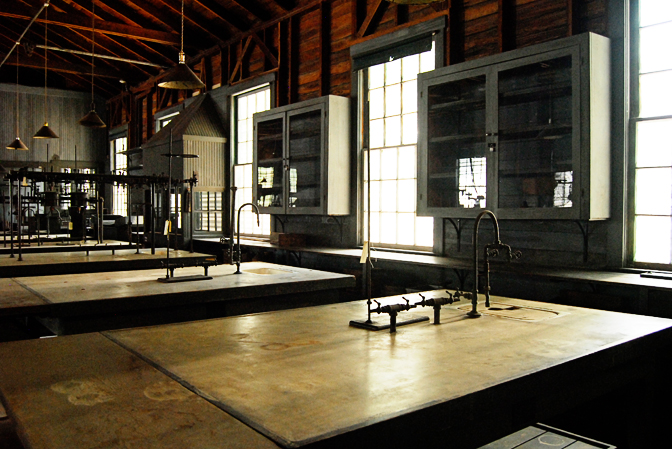
The last photo, I think, that I’ll post from Edison’s Winter home in Fort Myers, Florida. This is a photo of his lab where he developed many products and conducted one experiment after another. It seemed like a fun still life photo to post. And it was pretty incredible to be there—the place where this American inventor discovered so much that we take for granted today.

Sep 07 2010

Edison’s Trees

Filed under: Coastal Journal

I have chosen to post the photos of some of the trees on Thomas Edison’s estate in black and white. It seems like photographers do both when posting these types of photos. I guess it is a graphic, “arty” thing. The trees are very dynamic. They also have lines—lots of lines and usually that comes off well in the black and white format. The Banyan Tree in the above photo was a gift from tire industrialist Harvey Firestone in 1925. When the tree was planted, it was four feet high and two inches in diameter. Today the tree is an acre in diameter and has some 350 roots. After several years of studying natural materials that produced latex, Edison began to plant hundreds of varieties of plants on his Fort Myers property. The Banyan Tree was known for its latex—white milky sap.

This is a photo of the Mysore Fig tree also located on Edison’s property in Fort Myers, Florida. Edison studied it for its latex content. Ninety percent of its roots are external. The ones that are under ground are only 9″to 12″ deep!

Aug 17 2010

Friends Welcomed!

Filed under: Coastal Journal, Islands and Beaches

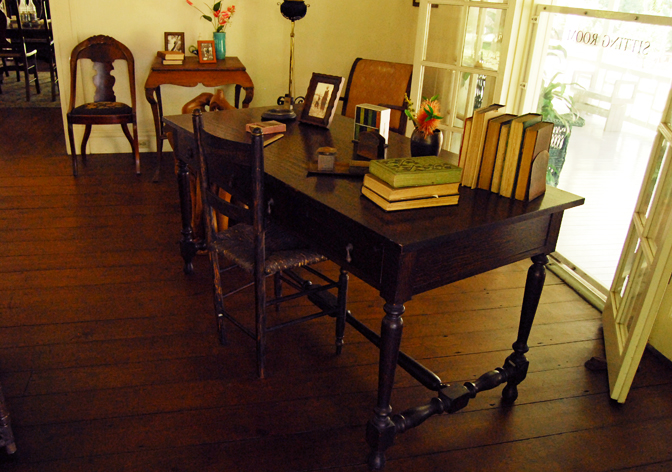
I loved the light on the top of these stairs in Henry Ford’s cottage (The Mangoes). And then below, most of you would know that I fell in love with the idea of Mina Edison writing long letters to friends and family at this desk in the sitting room of her Seminole Lodge. There were two homes included in Edison’s lodge. This is the house that many of their guests stayed in while visiting Ft. Myers. President Harding was often a visitor and stayed in this home.

Another thing that really struck me was how simply these people lived by today’s standards. Yes, all that they had was shipped to Ft. Myers from around the world but I can’t imagine any of America’s millionaires living this type of life style today. The pool was small and elevated. The tearoom floor below was tiny and very simple and the moonlight garden (in an earlier post) is the size of a postage stamp.

We really have so much more today, but it seems that we want even more! When we don’t get it, we end up feeling discontent and disadvantaged. Wonder what these men and their wives would do with all the advantages we have today? I’m not too sure that we are better off for all that we have gained. I do want to add a note here: these men were “self-made” men. They did not necessarily believe in God or that we have souls. At least that is what I have discovered about Edison. For him, when life ended, that was it, which is sad. One thing we can say, however, is that while he was alive he certainly knew how to enjoy the company of his friends.

Thomas Edison’s library and living area had some of the first electric lights. These are original to the house. I guess he just invented electricity and then had it installed in his home!

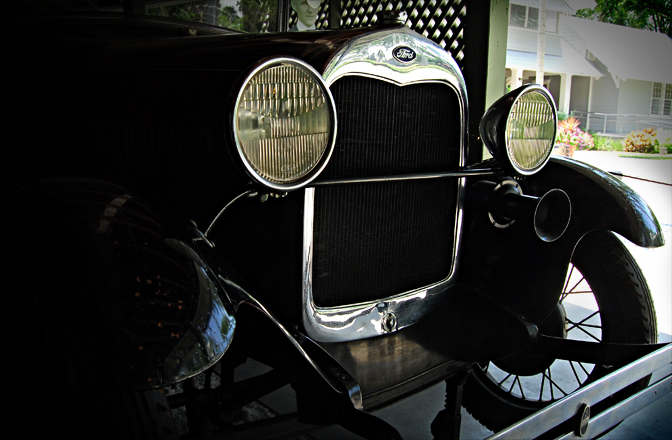
I have debated about including this story about Edison and Ford for a couple of weeks. It continues to make me laugh. So, I thought you would enjoy it. It’s from the archives of the Detroit News: “[Once while] en route to a new campsite on a rainy day, the Lincoln touring car carrying Harding, Ford, Edison, Firestone and naturalist Luther Burbank bogged down in deep mud on a back road in West Virginia. Ford’s chauffeur went for help and returned with a farmer driving an ancient Model T. After the Lincoln was yanked from the mire, Ford was the first to shake the farmer’s hand.

“I guess you don’t know me but I’m Henry Ford. I made the car you’re driving.”

A 1921 camping trip. From left, seated: Henry Ford, Thomas Edison, President Warren G. Harding, Harvey S. Firestone and George Christian. The man standing is unidentified.

Firestone chimed in, “I’m the man who made those tires.” Then he introduced two of the campers: “Meet the man who invented the electric light — and the President of the United States.”

Luther Burbank was the last to shake hands. “I guess you don’t know me either?” he asked.

“No,” said the farmer, “but if you’re the same kind of liar as these other darn fools, I wouldn’t be surprised if you said you was Santa Claus!”

Aug 11 2010

Edison’s Little Office – Mina’s Moonlight Garden

Filed under: Coastal Journal, Islands and Beaches

I was really drawn to Edison’s little office—probably because I love dark, wood spaces and places where you can sit and comfortably talk. The brochure I picked up at the Edison and Ford Estates said this cottage was built in 1929. Don’t you just love the phonograph in the back corner? Edison invented a tin-foil phonograph in 1877. The word phonograph was his trademark name. The sound quality, however, was pretty bad and a single recording lasted only for one play! Alexander Graham Bell later developed the graphophone, which used wax cylinders and could be played repeatedly.

The story of the “little office” (his term, not mine) is tangled. It was built to replace Edison’s original laboratory, which was dismantled and moved to Henry Ford’s Greenfield Village in Dearborn, Michigan in 1928. After the lab was  removed, Ford funded the construction of this office building and also the garden in the back, which was know as the Moonlight Garden. It became a favorite place of the Edisons as they grew older.

Water lilies, papyrus, and iris were three of Mina’s favorite plants. Ellen Biddle Shipman, who was one of the first female landscape architects, designed the garden. She filled it with blue and white flowers and a a small pool to reflect the moonlight.

Aug 02 2010

Friendships That Matter

Filed under: Coastal Journal, Islands and Beaches

Several years ago, I visited the Winter Estates of Thomas Edison and Henry Ford and came away being touched not by the power and fame these two men represented in America but by something much simpler—the friendship they shared. Edison and his family spent much more time at his Ft. Myers home than the Fords did, but whenever the two were together, you get a sense that they were friends in the most sincere sense.

When Edison learned that the home next to his two houses was on the market, he immediately asked Henry Ford if he wanted to purchase it. Ford had visited Edison in Ft. Myers many times so the natural thing for him to do was to live next next door to his friend. There are countless photos that have been taken of the two men and their families together at their winter estates. On occasion, they were joined by Harvey Firestone. The three men were on a hunt for a product that would make better tires, latex gloves, and much more. We can only imagine the conversations they had together.

One particular point of interest for me was the gate that stood between Thomas Edison’s Seminole Lodge and Henry Ford’s home, which was named: The Mangoes. It was called, The Friendship Gate. You can see where the original one was located in the photo above. When Ford was in Ft. Myers, the gate was always open. When he left, it was closed and not opened again until he returned. It was symbolic of their relationship and the “welcome” they had for one another. I don’t know why this very small jester has always stuck with me, but it has. It seems that friends come and go too easily these days. I once had a college professor ask a group of us if we could name five friends that we had known for ten years. No one could do this. These men, as powerful and as famous as they were, remained friends up until Edison’s death in 1931.

Some of the last words Edison spoke were of Henry Ford. He said, “I can only say that in the fullest meaning of the term, he is my friend.”